Showing posts with label Gemstones. Show all posts

Tuesday, 16 April 2013

Marble Bar Jasper - A beuatiful but hard to come by material

Marble Bar Jasper is a form of very fine grained silica found just outside the small outback town of Marble Bar, the town taking its name from the now famous 'jasper'.

Marble Bar Western Australia - Located south east of Port Hedland approximately 200km from the Great Northern Highway

The area was first colonized when gold was discovered. The 'Bar', as it is locally known was originally mistaken for marble and for the fact that it blocked the flow of the Coongan River.

The 'Bar' - Marble Bar Western Australia - Photo courtesy of 'The Grateful Dad' on Flickr
The jasper, or more accurately the fine grained silica, is a magnificent mix of red, white and blue/black striped rock. The colours in the stone are as a result of inclusions of mineral impurities such as iron ore causing the red (more commonly known as Hematite), pyrites and carbonaceous matter creating the blue/black tones. The white areas of the stone are more 'pure' forms of silica.


As it is now illegal to fossick and remove the material, doing so carrying a $10,000 fine, it is not unheard of to come across 'old stock' every now and again. The rough shown here was found at the recent Gemkhana show in Albury - I couldn't walk past it! In addition to the material shown here, I am also lucky enough to have a small supply of slabs which my Grandfather collected many many years ago.


Marble Bar Jasper Pendant - $40


Although this material is a jasper, forming part of the quartz family, I have always found it to be quite a bit softer than most other Jasper's that I have cut. In saying this, it still finished with a great shine/polish, and the patterns can be spectacular. You can see in the piece shown here how the stone has fractured, shifted and then re healed to form a very interesting piece of rock.


Marble Bar Jasper Pendant - $30


These two pieces also show the colour variations which are evident within the material.


Swiss Army Knife with Marble Bar Jasper Scales


All in all, Marble Bar Jasper is a beautiful and unique piece of natural geology which is admired by many. Unfortunately not all will have the pleasure of cutting this material, but leaving the natural environment of its origins intact is probably more important. I am one of the lucky ones!

Until next time!


Tuesday, 5 March 2013

New Opal Products Available

Some time ago I called for some expressions of interest for some opal triplet jewellery. I got some fairly positive feedback in relation to this expression of interest so I decided to go ahead and order some settings. They arrived yesterday so I was busy last night setting the triplets into the settings! They have all been uploaded into the store today!

4mm round opal triplet stud earrings


The first product is the 4mm round triplets set into sterling silver stud settings. An example of these is pictured to the left, and their are 4 sets available. I have been able to keep the price down to $12 per set.


5mm round opal triplet stud earrings


The second product is the 5mm round triplets set into sterling silver stud settings. An example of these is pictured to the right, and their are 6 sets available. I have been able to keep the price down to $15 per set.


6mm x 4mm Opal Triplet Earrings


The third product is the 6mm x 4mm triplets set into sterling silver kidney wire settings. An example of these is pictured to the left, and their are 5 sets available. I have been able to keep the price down to $15 per set.


7mm x 5mm Opal Triplet Earrings

And last, but by no means least, the flagship product of this particular release is the 7mm x 5mm triplets set into sterling silver kidney wire settings. An example of the is pictured to the right, and there are 5 sets of these available. I have been able to keep the price down to a low $20 per set.


I am hoping that these pieces will be successful, if they do turn out to be popular I will definitely be doing more releases, and perhaps even adding to the range. Keep an eye on my Facebook page for updates in relation to this!

Until next time!


Friday, 1 March 2013

Chalcedony

 
Free Form Designer Agate Cabochon

Chalcedony is a mineral made up mostly of Silicon Dioxide and is a cryptocrystalline variety of quartz. Chalcedony comes in many forms and is essentially a term for a group of semi precious gemstones, rather than a single stone. Chalcedony and its variants are considered among the most beautiful stones in the world and have a hardness rating of generally between 6.5 and 7 on the Mohs Hardness Scale.


The name 'Chalcedony' comes from the Latin word chalcedonius. However it is also believed that the original Latin word and the current usage of the name 'Chalecdony' derive from an ancient Greek settlement in Asia Minor. This settlement was originally known as Chalkedon, but the modern English interpretation of the settlement is Chalcedon - hence the spelling of the name 'Chalcedony'.  


This particular gemstone group has been used as long as humans have been utilising their surrounding materials. Some of the earliest and most primitive human tools that have been discovered have been made of various types of Chalcedony.

Chalcedonies are found in an immense array of colours including, black, blue, brown, colorless, gray, green, orange, red, violet, white, yellow, or any combination of these. 


Because of the vast array of varieties, the use of chalcedony eventually extended to that of decorative items. Native Americans for instance believe Chalcedony to be a sacred stone and it is used for ceremonial purposes. They believe that Chalcedony promotes stability within each tribe.


35mm x 18mm Heliotrope (Bloodstone)
Cabochon


As stated above, Chalcedony is essentially a term used to describe a broader group of gemstones which varies widely in colour and appearance. The most notable members of this group include gemstones such as Agate, Carnelian, Heliotrope (Bloodstone), Chrysoprase, Aventurine and Onyx, but has many other members as well. Chalcedony deposits in its various forms are found worldwide, with particular areas being known for or associated with the individual forms of chalcedony.


From a Lapidary Point of View
Because of the endless range of chalcedony forms, this particular stone is always going to please. From the Banding of Agates, through to the rich apple green of chrysoprase, to the spotted nature of Heliotrope, there is always going to be something of interest in a Lapidary sense. Some of the most eye catching and beautiful cabochons that I have cut have been some form of chalcedony or another. Most chalcedonies are at the harder end of the scale (with a Mohs rating of generally 6.5 to 7) and the compact crystalline structure of the material results in a beautiful mirror like finish. It is not surprising then that most lapidaries are more than happy to cut this material, and I am certainly no exception.

Free Form Designer Banded Agate Cabochon
Thanks for checking out my blog and certainly feel free to share with your friends. Remember, all of the pieces presented in this article have been cut by me and most are available for purchase (along with plenty of others!). Also don't forgot check us out on Facebook to keep up with all of our updates!

Until next time!

Sunday, 17 February 2013

Tiger Eye

Tiger Eye Rough - Image Courtesy of www.crystalsrocksandgems.com
Tiger Eye (or Hawks eye as the blue variety is known), a member of the quartz family, gets its chatoyant  nature (a cats eye type effect) as a result of its crocidolite content. Crocidolite is a mineral which is essentially fossilized asbestos fibres and is a blue colour.
African Tiger Eye Pendant - $30

How does Tiger Eye Form?
Tiger Eye is a member of the quartz family. It begins as blue mineral called crocidolite (Asbestos). This blue mineral is made up of iron and sodium components. The formation of Tiger Eye begins when quartz slowly replaces the crocidolite over time. The quartz embeds itself between the fibrous material. Once the process is completed, the resulting stone is either a golden brown (Tiger Eye) or a brilliant shimmering blue (Hawks Eye). As the stone forms, the iron and sodium content is completed removed. The replacing quartz takes on the same fibrous structure of the original material giving the stone its parallel lines. Because of the crystaline nature of the quartz, the movement of lights across the stone and its luster results. It is this property that makes tiger eye so popular and sort after.

African Tiger Eye Pendant - $45
What gives Tiger Eye its colour?
Although quartz replaces the iron and sodium content during the formation of the stone, trace amounts of iron oxide and other inclusions remain within the material. These trace amounts embed themselves between the remaining crocidolite and quartz. This composiyion creates the yellows and golden browns that are common in the stone. The blue Hawks Eye is a more 'pure' form of the stone having little inclusions remain but is rarer than the more common yellow. The third form of tiger eye, being red tiger eye, does not occur naturally. It comes about by heat treating tiger eye.


West Australian Tiger Eye Pendant - $20
Where Does Tiger Eye Occur?
The largest deposits of Tiger Eye are generally found in Africa, particularly South Africa and Namibia. Other deposits of this gemstone occur in Australia (particularly Western Australia), Burma, India, United States, Brazil, Canada, China, Korea and Spain. 

Tiger Iron
Tiger Iron is another common form of Tiger Eye which occurs mainly in South Africa and Western Australia. Tiger Iron is a banded gemstone comprising of lineal bands of Tiger Eye, Red Jasper and Black Hematite.
 
West Australian Tiger Iron Pendant - Custom made pendant

Lapidary Point of View
From a lapidary point of view, Tiger Eye is fantastic to cut. It is relatively hard measuring 6.5 to 7 on the Mohs hardness scale (some of the iron stone surrounding tiger eye can be a lot harder). In saying this, it can be somewhat frustrating at times as there is often differences in hardness between layers/bands which can cause a endless undercutting - something that can be very irritating. I have started plenty of Tiger Eye cabochons that have been discarded half way through as a result of this. The final product comes up with a magnificent shine with a beautiful chatoyant/lustres finish - This is what keeps me coming back to cutting the stuff!

All the pendants in this article have been cut by Jaka Gems. I am happy to consider custom orders of this gemstone as I currently have a reasonable supply of rough. Thanks for reading my blog! I would love for you to share this, or other articles on this blog, so feel free!

Until next time!

Wednesday, 6 February 2013

What is Opal?


Coober Pedy Jelly Opal - $90
Opal is one of the most popular stones in the world today. Its colour variations can be spectacular with bright reds, blues, greens, purples and everything in between. But what is opal and how does it occur? What process creates these brilliant colours that we see?


Boulder Opal Pendant & Earring Set - $125

One of the ways science defines a mineral is that which has a crystalline structure; Opal does not have such a structure, however it is generally referred to as a mineral. Despite this, Opal is in fact a 'Mineraloid' which is essentially a term that describes a geological substance which is lacking in a crystalline structure. Most mineraloids are still referred to as 'minerals' even though this is not strictly the case.


Queensland Boulder Opal Pendant - $95

Opals colour was a mystery for quite some time, with many theories being put forward in the early days. It wasn't until the 1960's, with the invention of the electron microscope, that it was discovered that opal was made of up of billions of tiny silica spheres all arranged in an orderly fashion. These spheres are roughly between, in the case of precious opal, 150 to 400 nanometers in diameter. This collection of silica spheres is formed via water mixed with silicon dioxide making its way through cracks and voids in the earths surface. Most of the water then evaporates (opal does have a small water content) leaving behind the tiny silica spheres. It is said that it takes some 4 million years for 1 centimetre of opal to form at a 45 metre depth.


Queensland Boulder Opal Cabochon - $295

The tiny spheres that make up the stone then diffract the light that enters the stone and divides it into the spectral colours. The colour shown is dependant on the size and arrangement of the tiny silica spheres present within the stone, and the colour patterns changes with the angle of the piece. If the spheres become too compact or unaligned, then the light will run straight through, without diffracting, creating opal with no colour play (this is commonly known as 'potch' or 'common opal').

Boulder Opal Pendant - $65


Coober Pedy Jelly Opal - $150

Pure opal is generally colorless, with impurities giving each piece its background colour. black opal, and opal with an orangey look to it have Iron, manganese oxides and organic carbon impurities giving them their background colour, whereas 'milky' or 'jelly' opal (such as that common in Coober Pedy) has tiny air pockets within the stone.


Coober Pedy Jelly Opal - $90

It is interesting to note that 97% of the worlds opal is mined in Australia with 80% of that coming from the mines of South Australia including Coober Pedy, Andamooka and Mintabie. Other opal deposits around the world can be found in the US (Particularly Nevada), Czech Republic, Slovakia, Hungary, Turkey, Indonesia, Brazil , Honduras, Guatemala, Nicaragua and Ethiopia. In an amazing announcement back in 2008, NASA also indicated that there were opal deposits found on Mars!

From a personal point of view, opal is one of my favourite stones to cut, although certainly comes with its own difficulties which can be somewhat frustrating. The colour play can quite often only be found within thin bands running through the material. Given the soft nature of the stone, this can quite often result in cutters grinding away too much material looking for better colour and ending up with no colour at all! This alone has proved enough to make a lot of people shy away from cutting a good bit of opal. My suggestion for those just starting out is to try your hand with some potch first, before going for the good stuff. At least this can give the cutter some sort of idea of how the stone runs across your grinding wheels and can give you a 'feel' for the material. The end result of a well cut opal can be stunning and makes the frustrating nature of the stone very much worthwhile!

I have put up photos of a few of my opals on this post, but you can see more of my work with this amazing material by checking out my store here. Until next time!


Sunday, 13 January 2013

Petrified Wood

Petrified Wood Pendant
Petrified Wood is essentially a fossil which originally occurs underground. The term Petrified Wood, meaning 'wood turned into stone', refers to the fossilized remains of trees.

Queensland Petrified Wood Cabochon

From a Lapidary perspective, Petrified Wood is a very hard material, having a hardness of roughly 7 on the Mohs Hardness Scale. This is because the wood fibers have been replaced by Agate which is a dense material.


Because of the agate content within, petrified wood takes a magnificent shine with an almost glassy finish.

Opalised Wood Cabochon
Petrified wood is formed when trees are submerged in sediment underground. The organic matter is preserved as a result of the lack of oxygen available within its surrounds. Mineralisation then occurs replacing the organic structure of the material with agatised material. This process leaves a 3D replica of the original organic material in stone.


Petrified Wood Pendant
Australia has many petrified wood deposits. The Chinchilla region (Queensland) is particularly famous for its 'Chinchilla Red' variety of petrified wood which tends to have plenty of red banding running through the material.

Queensland Petrified wood cabochon
However, the largest concentration of petrified wood in the world can be found in Arizona which is famous for its 'Petrified Forest'. This area is home to petrified logs of up to 60 metres!

Petrifed wood is one of my favourite materials to cut. As stated earlier, it finishes really well with a great shine, and because the original grain of the wood is still intact, the patterns can be amazing!


Queensland Petrified Wood Cabochon

All of the cabochons pictured on this post were cut by me. All of them are available for purchase through my online store.

Petrified Wood Pendant
Until next time!

Thursday, 6 December 2012

Chrysoprase - The apple of my eye!

Chrysoprase is one of those stones that people either love or hate. I for one am quite a fan, both from a lapidary and an aesthetic point of view.

16.3 carat Free Form Chrysoprase Cabochon - This piece is sold


Chrsyoprase, a variety of chalcedony, gets its apple green colouring from trace amounts of nickel found within its make up and the colour variations can range from pale to deep shades of green. It is this colour variation that makes the material more sort after than other forms of chalcedony.

18mm Round Green Chalcedony (Chrysoprase) Cabochon pendant - This piece is available for purchase here
Its structure is cryptocrystalline which essentially means that tiny crystals, crystals that are so small that they cannot be seen even under normal magnification, are packed together tightly to form the semi precious material.

15.35 Carat Free Form Chrysoprase Cabochon - This piece is available for purchase here
I personally find chrysoprase an absolute pleasure to cut. It is relatively hard, with a hardness rating of around 6 on the Mohs scale, which helps to give it a wonderful shine on the finished piece. It finishes well and the colour can be spectacular.

11.95 carat Free Form Chrysoprase Cabochon - This piece is available for purchase here

Australian Chrysoprase, particular that which is found in Queensland (In particular around the Marlborough Region) is amongst the worlds most sort after. These deposits occur in veins surrounded by geothite - a brown iron rich rock. It can also be found in Western Australia, Germany, Poland, Russia, the US and Brazil. One of the biggest known deposits is located in Szklary Poland.

Chrysoprase rough - Picture obtained from here


I will generally have at least a couple of pieces of Chrysoprase available in my store, so check back regularly! And dont forget to check out our Facebook page - Stop in and say hello!

Until next time!

Thursday, 22 November 2012

Cutting a rare Australian mineral - Gaspeite

Gaspeite - An extremely rare Australian mineral

I was recently talking to a friend of mine and we were discussing various different stones. She mentioned that she had seen a bright green stone pendant at a jewellers which she loved and asked if I could cut some for her. She couldn't remember the name of it, but said that it was apparently a very rare stone from Western Australia. I couldn't think of anything off the top of my head, but after we both did a bit of googling we figured out that the mineral she was talking about was Gaspeite.

Although the mineral was originally discovered in Canada, one, very small deposit of the nickel carbonate rock was discovered in the West Australian Desert. The Australian Gaspeite from that deposit is considered to be amongst the best and is the most sort after.

Gaspeite has a Mohs rating of approximately 4 1/2 to 5 making it relatively soft. I found it quite similar to cutting serpentine, and it was just as messy.

The Rough:

After a bit of searching, I managed to track down a small, cuttable piece of Australian Gaspeite from a dealer in Melbourne:

Australian Gaspeite Rough from Western Australia
Initially, I was a little bit disappointed with the piece once it arrived as it had a number of large cracks that ran quite deep. You can see one of the cracks in the photo above, which was the one of most concern to me.

The Custom Design:

After showing my friend the rough, we figured out what sort of shape she wanted, and that she was hoping to get a set to have a pendant and earrings made.

Here is the resulting cabochon set made up of 3 rectangular cabs:

Set of 3 Australian Gaspeite Cabochons

It turned out that my concerns about the cracks were warranted in some regard - you can see the remnants of one of the cracks in the small cab on the right in the picture. In saying this, it ended up giving the pieces a little bit of character with the small cracks and depressions surrounded by a nice polish. The stone itself polished well and was soft and easy to cut.

An Extra Cabochon:

After cutting the cabs for my friend, I had enough material left over to cut a free form cabochon:
 
Free Form Australian Gaspeite Cabochon

The crack in the middle of the stone seen above is the remnants of the large crack visible in the photo of the rough, but again I think it gives the piece a bit of character.

In the end, I didn't mind cutting Gaspeite; It finishes well with a nice shine (although plenty of other stones get a much higher polish) and it was relatively soft so was easy to cut. The above free from cabochon is currently available for purchase via my store:

Gaspeite Cabochon

And dont forget to check out my facebook page:

Jaka Gems on Facebook

Until next time!

Tuesday, 13 November 2012

How to cut a stone cabochon - Bloodstone Cabachon

A How-To Guide on Cutting Gemstone Cabochons

So how do you make a cabochon out of a rough chunk of rock?

Cutting a cabochon involves cutting and polishing a semi precious gem stone into a polished piece of rock with one flat side and one domed side. It is a fairly simple process once you know what you are doing, but it does take quite a bit of practice to perfect.

This is my quick guide on how to cut a stone cabochon which will hopefully give you some sort of idea on how the process works.

Equipment:

Essentially, the equipment that you will need is a lapidary trim saw (or a converted tile saw) and a cabochon machine. The other bits and pieces that are needed include a template and a scribe to mark out the shape of your cabochon on the stone. You may also want a waterproof apron because of the spray from the machines.

Safety Note: It is also worth noting at this point that precaution needs to be taken when cutting some stones and as a result, safety equipment such as eye protection and face masks may be needed. A couple of examples of this would be Nephrite Jade (which is closely related to asbestos) and Bumblebee Jasper (which has a high sulphur content).

Robilt Trim Saw

This is my trim saw, it is an old Robilt machine that belonged to my Grandfather. I recently had to rebuild the base. It is equipped with a 6 inch diamond blade and has a reservoir of water to keep the blade and stone cool whilst cutting. I also use an anti corrosion agent mixed in with the water to help lubricate the blade and to keep it all from rusting. 


CabKing Cabochon Machine
The cabochon machine I use is called a CabKing 6v3 (www.cabking.us). It is set up with 6 vertical wheels of varying grits and a polishing pad attached to the right hand side. These machines can be purchased via Aussie Sapphire (www.aussiesapphire.com.au) for around $2000.

The other machine that you may need is a slab saw (I have an old Robilt one that also belonged to my Grandfather) but slabs of rock are easy enough to come by without worrying about the expense of a large slab saw, which can become quite costly. Head to any gem show and you will find plenty, or search online.

If you don't like the sound of the $$$$ for the machines, a simple and cheap alternative is to join a local gem or lapidary club who have all the required equipment and plenty of experienced people to teach you the tricks of the trade.

Start up:


Heliotrope (Bloodstone) Rough

Captain Obvious: Start with a chunk of rock!


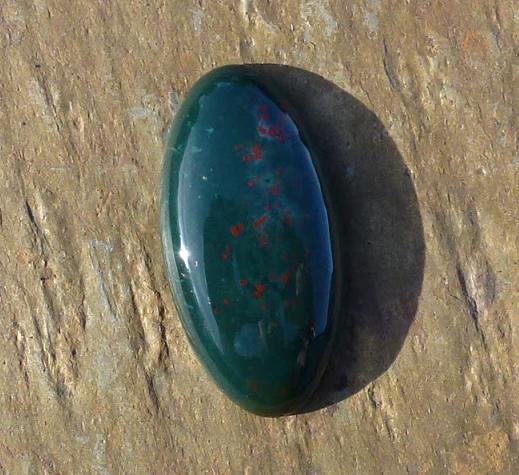
This is the piece we will work on today, it is a piece of Heliotrope (commonly known as Bloodstone) which originates from India. Heliotrope is a form of chalcedony which gets its nickname from the red inclusions of iron oxide or red jasper which look like blood splatters (see below).


Heliotrope (Bloodstone) Slab


The first step is to slab the chunk of rock into thin slices. It is generally accepted that either 1/4 inch (6.3mm) or 1/2 inch (12.7mm) is the standard thickness for a slab. My preference is for either the 1/4 inch or the 1/2 inch slabs, depending on the size of the cab (the thicker being better for large cabs and thinner better for smaller cabs).


The next step is to mark out your preferred cabochon shape and size using a scribe and template


Bloodstone slab marked for cutting


For this example I decided to go with a simple 35mm x 18mm oval standard cabochon. When being taught at a gem club, the simple oval shapes are generally the first that are taught with your first stone most likely being a 30mm x 40mm cabochon.


Basic Shape:

Heliotrope (Bloodstone) Rough 'Preform'


Using the trim saw, roughly cut out the general shape of the cabochon from the slab. It's best to remember that a saw blade is a bucket load cheaper than new wheels for your machine, so the more you take off the stone at this point, the less you need to take off with your diamond wheels.


Now it is time to move on to the cabochon machine. The most important part of the cabochon process is that you need plenty of water running over the diamond wheels. Without water, you will ruin your diamond wheels which can be a very costly mistake!

Metal Bonded Diamond Wheels on a Cabking 6V3


The first three wheels of the machine (pictured to the right) are used to shape the stone into a domed cut stone. The first two wheels are metal bonded diamond grinding wheels, the first is 80 grit and the second is 220 grit. The third wheel is a 280 grit resin bond diamond wheel.


Grind the remainder of the excess material from around where you have marked the shape, remembering to use plenty of water.

Bloodstone Shaped 'Preform'

At this point in the process, many people will attach the stone to what is known as a 'dop stick', which is basically a piece of dowel. You attach the stone to the dop with jewelers wax (some use 2 part epoxy glue, particularly with smaller stones) making sure that the stone is level and the dop is centered. I prefer not to dop, but that is simply a personal preference. I do however need to dop smaller cabs, ones that are too small to handle on their own. It is also common practice at this point to mark the center of the stone (on the top side) and to mark a line around the girdle just above the base of the stone. This helps the cutter maintain a standard height of the girdle around the edge and to help cut towards the middle of the dome. Again, all of this is personal preference.

Creating the Cabochon:

Cutting of Bloodstone Cabochon


Using the diamond grinding wheels, grind away the sharp edges of the stone, starting at a 45 degree angle.
You will end up with a 'flat' face right the way around the stone, and you will also end up with 2 edges instead of one.

Cutting of Bloodstone Cabochon


Follow the same process to remove the 2 new edges.
Keep working on the edges that are created by the grinding wheels by working the stone around the wheel.


Cutting of Bloodstone Cabochon


Eventually you will end up with a domed piece of stone................


Which looks something like this when dry:

Cutting of Bloodstone Cabochon
If you look closely, the white bits on the picture above are actually scratches made by the tiny diamonds in the wheels. You can only really see them when the stone is dry, but with experience you will be able to feel them when the stone is wet and wont need to dry it each time you need to check if they are still there. The next wheel (the 280 grit resin bonded wheel) cleans a lot of these bigger scratches off. In this following picture, you can see that I have run the top half of the stone over that 280 grit wheel:

Cutting of Bloodstone Cabochon

Cutting of Bloodstone Cabochon


The stone after the 280 grit wheel:

As you can see, all of those bigger white scratches have been removed by the 280 grit wheel. If you were to look closely, you would see that the stone is still covered with tiny white scratches, but they are a lot smaller than in the photo above. This is why the stone still looks quite dull.

Pre Polish: 

Resin Bonded Diamond Wheels on the Cabking 6V3


The next three wheels on the machine are for the pre polish. All three are resin bonded wheels with grits (left to right) of 600, 1200 and 3000. Essentially what each wheel does is put finer and finer scratches on the stone to give it a shine, these wheels also smooth off any ridges or edges left by the courser grit wheels. Again, you need plenty of water running over each of the wheels to lubricate.


Cutting of Bloodstone Cabochon


The stone after the 600 grit wheel:


Cutting of Bloodstone Cabochon


After the 1200 grit wheel:


Cutting of Bloodstone Cabochon


 And after the 3000 grit:


Final Polish:

2 Gram Syringe of 14,000 Grit Diamond Paste


For the final polish I use a canvas polishing pad coupled with 14,000 grit diamond paste which is purchased in 2 gram syringes. Many cabbers will follow the previous steps up to 100,000 grit, then polish with cerium oxide paste.


Canvas Polishing Pad attached to end of Cabking 6V3
The pad attaches to the side of the CabKing machine (as seen in the picture to the right). The final polish is the easiest part of the whole process, but if you have missed any scratches in the previous steps, they will stick out like the proverbials after the polish! You simply start the machine and run the whole stone over the polishing pad for a couple of minutes. Water is optional at this point, however if you decide not to use water you need to take care to ensure that the stone doesnt heat up too much as this may cause the stone to crack or break.


Don't forget to put a small beveled edge (on a 45 degree angle) on the back of the cabochon to avoid chipping:


The final product:

Finished Heliotrope (Bloodstone) Cabochon

All that is left to do is take a nice photo of the cab - I am still working on this bit - my wife is a far better photographer than I!

Finished Heliotrope (Bloodstone) Cabochon

Thanks for checking out my blog! I hope that you have got something out of this 'crash course' in cabochon cutting. The above stone is available for purchase through my store here along with plenty of others. Please also check out my faceboook page aswell - www.facebook.com/jakagems

Feel free to leave some feedback, let me know how I can improve this how to guide, or let me know if you have any questions!

Until next time!